Online Degree Accreditation 2026: Your Essential Guide

Anúncios
The 2026 Landscape of Online Degree Accreditation: What You Need to Know Before Enrolling
In an increasingly digital world, online education has become a cornerstone of lifelong learning, offering unparalleled flexibility and access. As we step into 2026, the landscape of online learning continues to evolve, making the critical aspect of Online Degree Accreditation more important than ever. For prospective students, understanding the nuances of accreditation is not just a recommendation; it’s a necessity to ensure their educational investment yields recognized and valuable credentials. This comprehensive guide will navigate the complexities of online degree accreditation in 2026, equipping you with the knowledge to make informed decisions and avoid common pitfalls.
Anúncios
The proliferation of online programs has brought with it a varied quality spectrum. Without proper accreditation, an online degree, no matter how rigorous its curriculum appears, might be worthless in the eyes of employers, licensing boards, or other educational institutions. The goal of this article is to demystify online degree accreditation, highlighting what to look for, what to avoid, and how to verify the legitimacy of your chosen program. We’ll delve into the various types of accreditation, the role of accrediting agencies, and the specific considerations for 2026 and beyond.
Understanding the Basics of Online Degree Accreditation
Before diving into the specifics of the 2026 landscape, it’s crucial to grasp the fundamental concept of Online Degree Accreditation. Accreditation is a process of external quality review that higher education institutions and programs undergo. It assures the public that an institution or program meets established standards of quality and integrity. For online degrees, this process is particularly vital because the physical presence of a campus, which often signals legitimacy, is absent.
What is Accreditation and Why Does It Matter for Online Degrees?
Accreditation, at its core, is a seal of approval. It signifies that an educational institution or program has been evaluated by an independent agency and found to meet specific standards of academic quality, institutional integrity, and operational effectiveness. For online degrees, this is paramount for several reasons:
- Employer Recognition: Many employers will only consider candidates with degrees from accredited institutions. Without it, your degree might not be recognized, hindering your career prospects.
- Transferability of Credits: If you plan to transfer credits from one institution to another, or pursue further education, those credits are almost universally accepted only if they come from an accredited program.
- Financial Aid Eligibility: In the United States, federal financial aid is only available to students attending institutions accredited by agencies recognized by the U.S. Department of Education (USDE).
- Professional Licensure: Many professions require a degree from an accredited program to qualify for licensure or certification.
- Quality Assurance: Accreditation ensures that the curriculum is robust, faculty are qualified, student support services are adequate, and the institution is financially stable.
Types of Accreditation: Regional vs. National vs. Programmatic
There are generally three main types of accreditation relevant to online degrees, each with distinct implications:
- Regional Accreditation: This is considered the gold standard for academic institutions in the United States. There are six regional accrediting bodies, each overseeing institutions in a specific geographic area. Regionally accredited degrees are widely accepted for credit transfer and by employers and graduate schools. Most traditional, non-profit universities hold regional accreditation.
- National Accreditation: National accreditation is typically granted to vocational, technical, or trade schools, as well as some faith-based institutions. While valid, nationally accredited degrees often have limited transferability to regionally accredited institutions and may not be as widely recognized by employers or graduate programs outside of specific vocational fields.
- Programmatic Accreditation: Also known as specialized or professional accreditation, this applies to specific programs, departments, or schools within a larger institution. For example, an engineering program might have accreditation from ABET (Accreditation Board for Engineering and Technology), or a business program from AACSB (Association to Advance Collegiate Schools of Business). This type of accreditation ensures that the program meets the standards of a particular profession.
For most online degree seekers aiming for broad recognition and career flexibility, seeking a regionally accredited institution offering a program with relevant programmatic accreditation (if applicable to your field) is the safest and most recommended path. The 2026 landscape continues to emphasize regional accreditation as the benchmark for academic quality.
Anúncios
The 2026 Landscape: Key Changes and Considerations for Online Degree Accreditation
As technology advances and the demand for flexible learning options grows, the regulatory environment for Online Degree Accreditation is continuously adapting. While the core principles remain, 2026 brings specific trends and considerations that prospective students should be aware of.
Increased Scrutiny on Online Program Quality
With the rapid expansion of online offerings, accrediting agencies are increasing their scrutiny of the quality and rigor of online programs. This includes closer examination of:
- Faculty Qualifications and Training: Ensuring that faculty teaching online courses are not only experts in their field but also proficient in online pedagogy.
- Student Support Services: Verifying that online students have access to adequate academic advising, technical support, library resources, and career services.
- Technology Infrastructure: Assessing the robustness and reliability of the learning management systems and other technological tools used for course delivery.
- Outcomes Assessment: A greater emphasis on demonstrating measurable student learning outcomes that are comparable to their on-campus counterparts.
This heightened scrutiny benefits students by ensuring a higher standard of education, but it also means that institutions must be more transparent about how they meet these standards.
The Role of the Council for Higher Education Accreditation (CHEA) and the U.S. Department of Education (USDE)
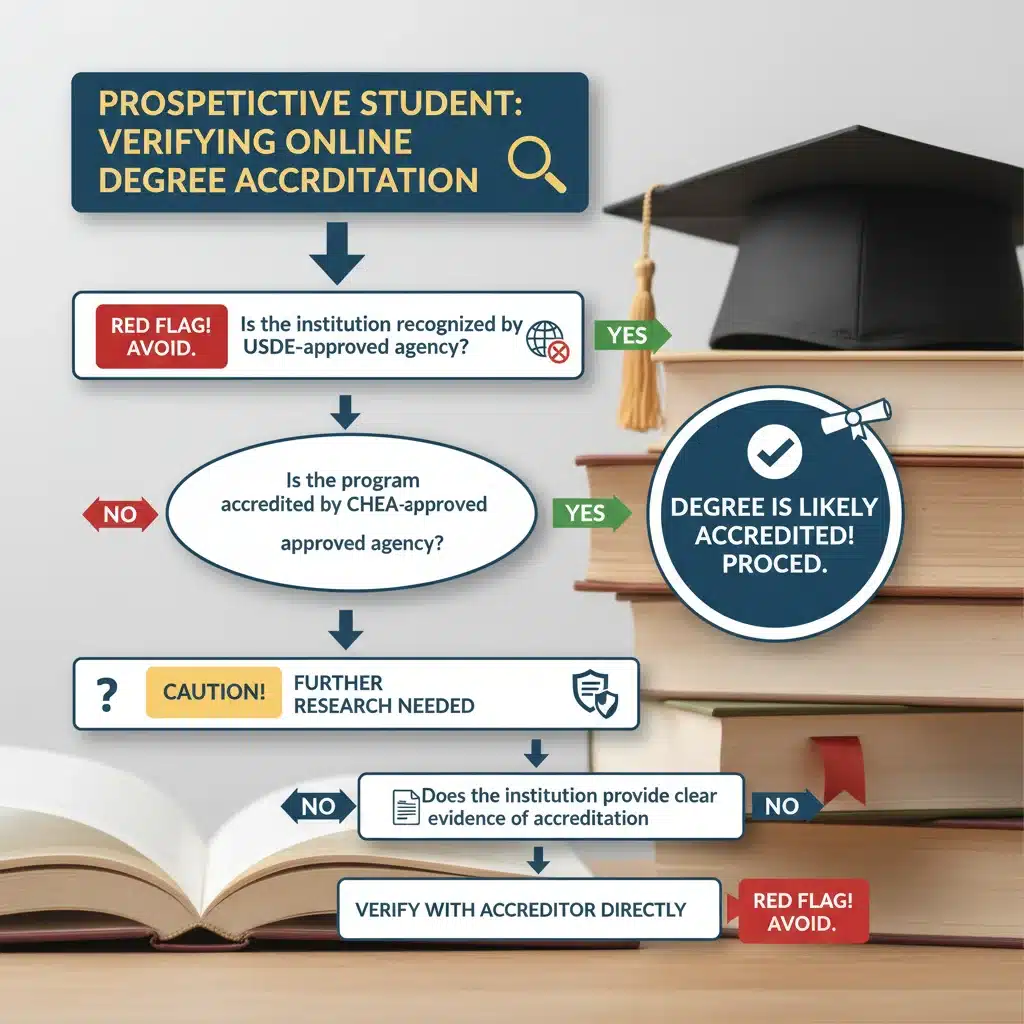
In the U.S., the integrity of the accreditation system is maintained by two key entities: the Council for Higher Education Accreditation (CHEA) and the U.S. Department of Education (USDE). Both recognize accrediting agencies that meet their rigorous standards. For 2026, it’s paramount to ensure that the accrediting agency for your chosen institution or program is recognized by either CHEA or the USDE. This recognition is the ultimate assurance of legitimacy.
- CHEA: A private, non-profit organization that reviews and recognizes approximately 60 institutional and programmatic accrediting organizations. CHEA’s role is to promote academic quality and to certify the quality of accrediting organizations.
- USDE: The federal government’s role is to ensure that accrediting agencies are reliable authorities as to the quality of education or training offered by the institutions or programs they accredit. USDE recognition is essential for institutions whose students wish to receive federal financial aid.
Always cross-reference an institution’s claims of accreditation with the official lists provided by CHEA and the USDE. This simple step can save you from enrolling in an unaccredited or ‘accreditation mill’ program.
Emerging Trends: Micro-credentials and Alternative Pathways
While traditional degrees remain central, 2026 is seeing a rise in the importance of micro-credentials, bootcamps, and other alternative learning pathways. While these are not always ‘degrees’ in the traditional sense, their accreditation and recognition are becoming increasingly important. Students pursuing these options should inquire about any industry certifications, professional body endorsements, or recognition by employers that these programs carry. While not strictly Online Degree Accreditation, the principles of quality assurance and external validation still apply.
Identifying Red Flags: What to Watch Out For When Researching Online Degree Accreditation
The digital age, unfortunately, also brings with it opportunities for deceptive practices. Diploma mills and unaccredited institutions prey on unsuspecting students. Knowing the red flags associated with Online Degree Accreditation is crucial for protecting your investment and your future.
Common Tactics of Diploma Mills and Unaccredited Institutions
Be wary of institutions that exhibit any of the following characteristics:
- Accreditation Claims from Unrecognized Agencies: They might claim to be accredited, but by an agency not recognized by CHEA or the USDE. Always verify.
- Too Good to Be True Promises: Instant degrees, degrees based solely on life experience (with little to no academic rigor), or exceptionally low tuition fees for prestigious-sounding degrees.
- Lack of Transparency: Difficulty finding information about their accreditation status, faculty credentials, physical address, or student services.
- Aggressive Sales Tactics: Pressure to enroll quickly, large discounts for immediate enrollment, or refusal to provide detailed program information.
- Unusual Domain Names or Website Quality: Websites that look unprofessional, have numerous grammatical errors, or use generic domain names (e.g., .info, .biz instead of .edu for U.S. institutions).
- No Interaction: Programs that don’t require any interaction with faculty or other students, or have no real assignments or exams.
- Use of Similar Names: Institutions with names very similar to well-known, legitimate universities, intended to confuse prospective students.
The Importance of Due Diligence
The responsibility ultimately lies with the student to perform due diligence. This means:
- Verifying Accreditation: Use the CHEA and USDE websites as your primary resources. Search for the institution and the accrediting agency they claim.
- Researching the Institution: Look for reviews, news articles, and any complaints filed against the institution. Check their history and reputation.
- Contacting the Institution Directly: Ask specific questions about their accreditation, faculty, curriculum, and student support.
- Consulting with Employers or Professional Boards: If you’re pursuing a degree for a specific career path, ask potential employers or relevant professional licensing boards if they recognize degrees from the institution you’re considering.
Navigating the Accreditation Process: A Step-by-Step Guide for Prospective Students
Making an informed decision about your online education requires a structured approach to verifying Online Degree Accreditation. Here’s a step-by-step guide to help you through the process in 2026.
Step 1: Identify Your Educational Goals and Career Path
Before you even start looking at institutions, have a clear understanding of what you want to achieve with your degree. What career path are you aiming for? What level of education do you need? This will help you narrow down your choices and understand what type of accreditation (regional, national, or programmatic) is most relevant to your goals.
Step 2: Research Potential Institutions and Their Accreditation Claims
Once you have a list of potential online programs, visit their official websites. Look for a clear statement about their accreditation. Legitimate institutions will prominently display this information, often on their ‘About Us’ or ‘Accreditation’ pages. Note down the name of the accrediting agency.
Step 3: Verify the Accrediting Agency with CHEA and USDE
This is the most critical step. Go to the official websites of the Council for Higher Education Accreditation (www.chea.org) and the U.S. Department of Education (www.ed.gov). Use their search tools to confirm that the accrediting agency claimed by the institution is recognized by them. If the agency is not listed, proceed with extreme caution.
Step 4: Verify the Institution’s Accreditation Status
After confirming the accrediting agency’s legitimacy, visit the agency’s website directly. Most accrediting agencies have a public directory of their accredited institutions. Search for your prospective institution by name to confirm its current accreditation status. Pay attention to the scope of accreditation (e.g., specific programs or the entire institution) and any notes about probationary status or warnings.
Step 5: Check for Programmatic Accreditation (If Applicable)
For certain fields (e.g., nursing, engineering, education, business), programmatic accreditation is as important as institutional accreditation. Identify the relevant programmatic accrediting body for your chosen field (e.g., ABET for engineering, AACSB for business) and verify the program’s status directly on their website.
Step 6: Investigate Further and Ask Questions
If everything checks out so far, don’t stop there. Reach out to the admissions office with any remaining questions. Ask about faculty qualifications, student-to-faculty ratios in online courses, student support services specifically for online learners, and career placement rates. You can also look for alumni testimonials or independent reviews.
The Future of Online Degree Accreditation Beyond 2026
The landscape of Online Degree Accreditation is not static; it’s a dynamic environment that will continue to evolve. Looking beyond 2026, several trends are likely to shape how online degrees are accredited and perceived.
Adaptation to New Technologies and Learning Modalities
Accrediting agencies will increasingly need to adapt their standards to accommodate emerging technologies like artificial intelligence (AI) in learning, virtual reality (VR) classrooms, and adaptive learning platforms. The focus will remain on ensuring pedagogical effectiveness and student outcomes, regardless of the technology used for delivery.
Global Harmonization of Standards
As online education becomes more global, there may be a push towards greater harmonization of accreditation standards internationally. This could facilitate easier recognition of online degrees across borders, benefiting students and institutions alike. However, this is a complex undertaking and will likely be a long-term development.
Focus on Employability and Workforce Needs
Accreditation will likely place an even greater emphasis on the employability outcomes of graduates. This means closer ties between accrediting bodies, educational institutions, and industry to ensure that online programs are producing graduates with the skills and competencies demanded by the modern workforce. Data on graduate employment, salary, and career progression will become even more critical in the accreditation review process.

Emphasis on Student Well-being and Mental Health Support
With the unique challenges that online learning can present, accrediting bodies may increasingly integrate standards related to student well-being, mental health support, and fostering a sense of community among online learners. This holistic approach ensures that students are not only academically supported but also thrive in their learning environment.
Conclusion: Making an Accredited Choice for Your Future
The decision to pursue an online degree is a significant one, promising flexibility and access to education that might otherwise be out of reach. However, the value of that degree hinges almost entirely on its accreditation. As we’ve explored the 2026 landscape of Online Degree Accreditation, it’s clear that vigilance and informed decision-making are paramount.
By understanding the types of accreditation, recognizing red flags, and diligently verifying the credentials of your chosen institution and program, you safeguard your educational investment. An accredited online degree opens doors to career advancement, further academic pursuits, and professional recognition. Conversely, an unaccredited degree can lead to wasted time, money, and missed opportunities.
Remember to always prioritize institutions accredited by agencies recognized by CHEA and the USDE. Take the time to research, ask questions, and verify every claim. Your future success depends on it. In 2026 and beyond, a properly accredited online degree is not just a piece of paper; it’s a testament to quality education and a passport to a brighter future.