
Maximizing Social Security Spousal Benefits for Those Over 65 in 2026: A Comprehensive Guide
For millions of Americans, Social Security represents a cornerstone of their retirement security. As we approach 2026, understanding the nuances of how to maximize your Social Security Spousal Benefits becomes increasingly critical, especially for those aged 65 and older. The rules and strategies can be complex, but with careful planning, couples can significantly boost their combined lifetime benefits. This in-depth guide will walk you through the essential considerations, claiming strategies, and important updates to help you navigate the system effectively and ensure a more financially secure retirement.
Understanding Social Security Spousal Benefits
Before diving into specific strategies, it’s crucial to grasp the fundamental concept of Social Security Spousal Benefits. These benefits are designed to provide financial support to spouses or divorced spouses based on their partner’s (or ex-partner’s) work record. They are not tied to your own work record in the same way your primary worker benefit is. Here’s a breakdown:
Anúncios
- Eligibility: To claim spousal benefits, your spouse must generally be receiving their own Social Security retirement or disability benefits. You must also be at least 62 years old, or any age if you are caring for the worker’s child who is under age 16 or disabled.
- Benefit Amount: A spousal benefit can be up to 50% of your spouse’s Primary Insurance Amount (PIA) – the amount they would receive at their Full Retirement Age (FRA). However, this amount can be reduced if you claim before your own FRA.
- Full Retirement Age (FRA): Your FRA for spousal benefits is the same as your FRA for your own worker benefits. For those born between 1943 and 1954, FRA is 66. For those born in 1960 or later, FRA is 67. For those born between these years, it’s a staggered age in between. Knowing your FRA is paramount for maximizing Social Security Spousal Benefits.
- Coordination with Your Own Benefits: If you are eligible for both your own worker benefit and a spousal benefit, the Social Security Administration (SSA) will pay you your own benefit first. If your spousal benefit is higher, you will receive an additional amount to bring your total benefit up to the spousal benefit level. You generally cannot receive both in full simultaneously.
Understanding these basic tenets is the first step toward effective planning. Many couples over 65 overlook the potential for significant increases in their total household income by not fully optimizing their spousal benefit claims.
Key Considerations for Spouses Over 65 in 2026
For individuals already aged 65 or older, certain factors become particularly relevant when planning to claim Social Security Spousal Benefits in 2026. Your age relative to your Full Retirement Age (FRA) and your spouse’s claiming status will heavily influence your optimal strategy.
1. Your Full Retirement Age (FRA)
If you are 65 in 2026, your FRA is likely 66, 66 and a few months, or 67, depending on your birth year. Claiming spousal benefits before your FRA will result in a permanent reduction. For instance, if your FRA is 67 and you claim at 65, your spousal benefit will be less than 50% of your spouse’s PIA. Waiting until your FRA ensures you receive the maximum 50% if that is the higher amount.
2. Your Spouse’s Claiming Status
For you to claim Social Security Spousal Benefits, your spouse must have already filed for their own retirement benefits. If your spouse has not yet claimed, they might consider doing so to enable you to receive your spousal benefit, even if they plan to suspend their own benefits (if permitted by rules in 2026, which is an important point to verify as rules change). However, ‘File and Suspend’ as it was known pre-2016 is largely gone, impacting some strategies.
3. Your Own Earning Record
If you have your own substantial earnings record, the SSA will first pay you your own retirement benefit. If the spousal benefit (50% of your spouse’s PIA at your FRA) is higher than your own PIA, you will receive your PIA plus an additional amount to reach the spousal benefit level. If your own PIA is higher, you will simply receive your own benefit, as the spousal benefit would not increase your payment.
Anúncios
4. Delayed Retirement Credits (DRCs) for Spouses
A common misconception is that spousal benefits also earn Delayed Retirement Credits. This is incorrect. While your own worker benefit increases by 8% per year for each year you delay claiming past your FRA (up to age 70), spousal benefits do not earn DRCs. This means there is generally no financial incentive to delay claiming spousal benefits beyond your own FRA. However, if you are delaying your own benefit to earn DRCs, you might be able to claim a restricted application for spousal benefits if you were born before January 2, 1954, and have reached your FRA. This is a crucial point for older individuals to investigate for 2026.
Advanced Claiming Strategies for Maximizing Spousal Benefits in 2026
Now, let’s explore specific strategies that couples over 65 can employ to maximize their Social Security Spousal Benefits in 2026. The best strategy depends heavily on individual circumstances, including birth dates, earnings records, and overall retirement goals.
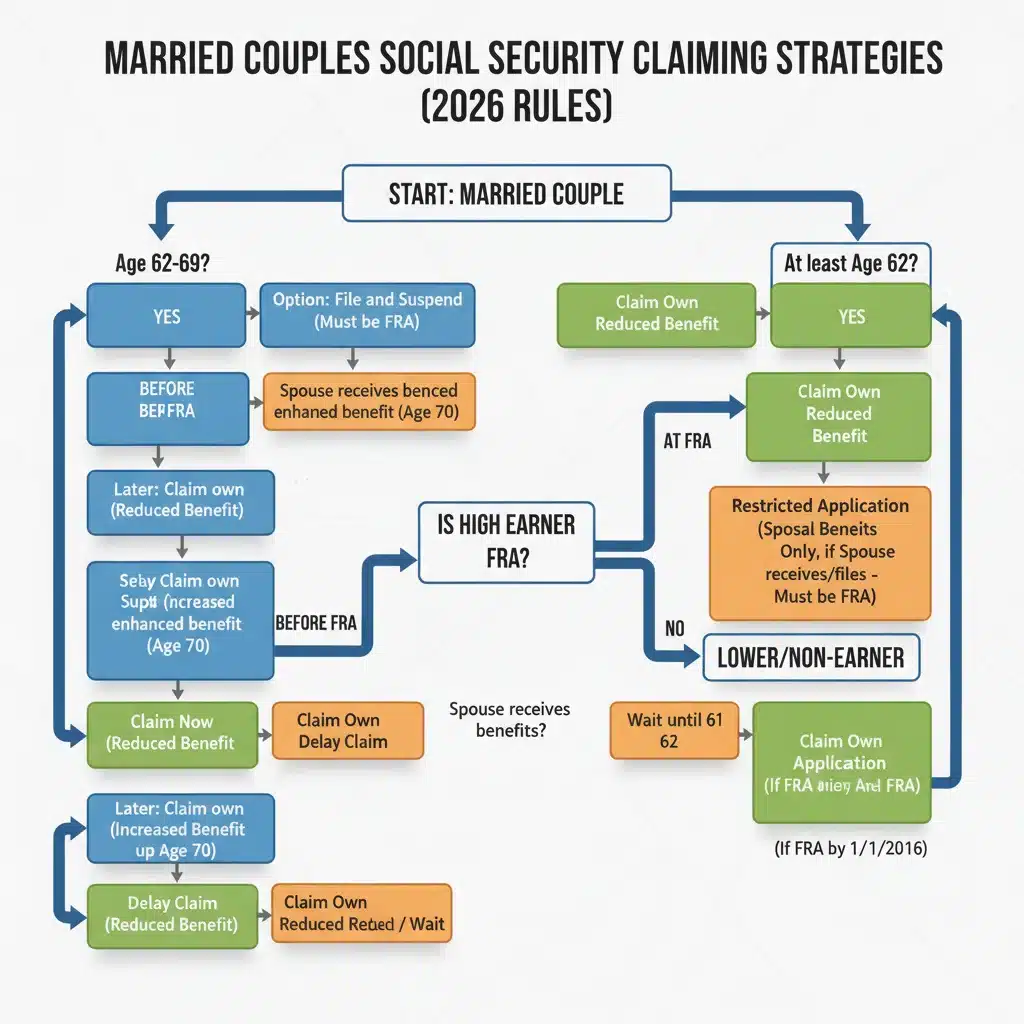
Strategy 1: Spousal Benefit First (Restricted Application) – For those born before January 2, 1954
This is arguably one of the most powerful strategies, though its applicability is narrowing. If you were born before January 2, 1954, and have reached your Full Retirement Age, you have the option to file a ‘restricted application’ for spousal benefits only. This allows you to claim 50% of your spouse’s PIA while your own worker benefit continues to grow, earning Delayed Retirement Credits (DRCs) until age 70. At age 70, you would then switch to your own maximized benefit, which would be significantly higher due to the DRCs.
Example for 2026: Let’s say one spouse (Spouse A, born before Jan 2, 1954) is 68 in 2026 (past their FRA) and the other spouse (Spouse B) has already claimed their benefits. Spouse A can claim a spousal benefit based on Spouse B’s record. Meanwhile, Spouse A’s own benefit continues to grow by 8% per year until age 70. At 70, Spouse A switches to their higher, delayed benefit. This strategy effectively provides a ‘bridge’ income while optimizing personal benefits.
Important Note: This strategy is only available to a specific age cohort. If you were born after January 1, 1954, you cannot restrict your application to spousal benefits only. When you apply for any Social Security retirement benefit, you are ‘deemed’ to apply for all benefits you are eligible for (your own and spousal), and you will receive the higher of the two.
Strategy 2: Delaying the Higher Earner’s Benefit
This strategy is crucial for most couples, regardless of birth year. The higher-earning spouse (or the spouse with the higher PIA) should generally delay claiming their own benefits until age 70, if possible. This maximizes their individual benefit through Delayed Retirement Credits, which in turn maximizes the potential survivor benefit for the surviving spouse. It also provides the highest possible base for any spousal benefits claimed by the lower-earning spouse.
While the higher earner delays, the lower-earning spouse (if at their FRA) can claim their own benefit or a spousal benefit (if the higher earner has already claimed or if the restricted application applies). The goal is to let the largest benefit grow as much as possible.
Considerations:
- Health and Life Expectancy: If the higher-earning spouse has significant health issues and a shorter life expectancy, delaying might not be the optimal choice.
- Immediate Income Needs: If the couple needs the income immediately, delaying might not be feasible without other substantial retirement savings.
Strategy 3: Coordinated Claiming for Equal Earners
In cases where both spouses have similar earnings records and relatively similar PIAs, the strategy becomes more balanced. One approach is for both spouses to delay claiming their own benefits until their respective FRAs, or even until age 70, if financial circumstances allow. This ensures both benefits are maximized. Spousal benefits might become less relevant if both individuals have high PIAs.
However, if one spouse’s PIA is slightly lower, the higher earner could delay to 70, and the lower earner could claim their own benefit at FRA. Once the higher earner claims at 70, the lower earner might then be eligible for an increased spousal benefit if 50% of the higher earner’s *new, higher* PIA (at 70) is greater than their own PIA. This requires careful calculation.
Strategy 4: Spousal Benefits for Divorced Spouses Over 65
Divorced spouses can also claim Social Security Spousal Benefits, which is a frequently overlooked opportunity. If you were married for at least 10 years, are currently unmarried, are age 62 or older, and your ex-spouse is entitled to Social Security retirement or disability benefits, you can claim benefits based on their record. Importantly, your ex-spouse does not need to have claimed their benefits for you to claim yours, as long as they are at least 62 and the divorce has been final for at least two years.
For those over 65 in 2026, if you meet these criteria and were born before January 2, 1954, you could potentially use the ‘restricted application’ strategy mentioned earlier, allowing your own benefit to grow until age 70 while you collect spousal benefits from your ex-spouse’s record. This can be a significant boost to your retirement income.
Impact of Cost-of-Living Adjustments (COLAs) and Future Changes in 2026
Social Security benefits are subject to annual Cost-of-Living Adjustments (COLAs), which are designed to help benefits keep pace with inflation. While the exact COLA for 2026 won’t be announced until late 2025, it’s an important factor in the long-term value of your benefits. COLAs apply to both worker and spousal benefits.
It’s also crucial to stay informed about potential legislative changes to Social Security. While major overhauls are difficult to predict, beneficiaries should always be aware of any proposed adjustments to claiming ages, benefit calculations, or eligibility rules, as these could impact future Social Security Spousal Benefits. Reliable sources like the Social Security Administration’s official website are the best places for up-to-date information.
For 2026, the earnings limit for those who are working while collecting benefits (before FRA) will likely be adjusted upwards. If you are over 65 but not yet at your FRA and plan to work, be mindful of these limits. If you earn above the limit, some of your benefits may be withheld, though they are usually repaid in the form of higher future benefits once you reach FRA.
Practical Steps to Take for Spouses Over 65
Navigating the complexities of Social Security Spousal Benefits requires proactive planning. Here are practical steps you should take:
1. Access Your Social Security Statement
Both you and your spouse should create an account at ssa.gov/myaccount to access your personalized Social Security statements. These statements provide estimates of your retirement benefits at different claiming ages, your earnings record, and potential spousal or survivor benefits. This data is the foundation of any planning.

2. Determine Your Full Retirement Age (FRA)
Accurately identify your FRA and your spouse’s FRA. This is a critical data point that informs all claiming decisions, especially concerning reductions for early claiming and the availability of restricted applications.
3. Calculate Potential Scenarios
Use online calculators or work with a financial advisor to model different claiming scenarios. Compare the total lifetime benefits of various strategies: one spouse claiming early, both delaying, one taking spousal benefits while the other delays, etc. Consider the impact of life expectancy on these calculations.
4. Understand the Deeming Rule
If you were born after January 1, 1954, remember the ‘deeming rule.’ When you apply for any Social Security retirement benefit, you are automatically deemed to have applied for all benefits you are eligible for (your own and spousal), and the SSA will pay you the higher of the two. This means the ‘restricted application’ strategy is not available to you.
5. Consider Survivor Benefits
When planning, always think about survivor benefits. The surviving spouse will receive the higher of their own benefit or 100% of the deceased spouse’s benefit. Therefore, maximizing the higher earner’s benefit is often the best strategy for overall family financial security, especially for the surviving spouse over 65.
6. Seek Professional Advice
Given the complexity and the significant financial implications, consulting with a financial advisor specializing in Social Security planning is highly recommended. They can help you analyze your specific situation, navigate the rules, and develop a personalized strategy to maximize your Social Security Spousal Benefits for 2026 and beyond.
Common Misconceptions About Social Security Spousal Benefits
To ensure you make informed decisions, it’s important to dispel some common myths:
- Myth 1: Spousal benefits reduce your spouse’s benefit. This is false. Your claiming of spousal benefits has no impact whatsoever on your spouse’s own benefit amount.
- Myth 2: You can earn Delayed Retirement Credits on spousal benefits. As discussed, this is incorrect. Spousal benefits do not increase past your own Full Retirement Age.
- Myth 3: You have to claim your own benefits first. Not always. For those born before January 2, 1954, at FRA, you can restrict your application to spousal benefits only. For others, the deeming rule applies.
- Myth 4: You lose spousal benefits if you remarry. If you remarry, your eligibility for spousal benefits based on a previous spouse’s record generally ends, unless your subsequent marriage ends (by death, divorce, or annulment). However, you might become eligible for spousal benefits based on your new spouse’s record.
Dispelling these myths is crucial for effective planning and for ensuring you don’t miss out on potential benefits.
The Role of Life Expectancy in Claiming Decisions
Life expectancy plays a significant role in determining the optimal claiming strategy for Social Security Spousal Benefits. While no one can predict the future, general health, family history, and lifestyle choices can offer clues. If both spouses anticipate a long life, delaying the higher earner’s benefit until age 70 often yields the greatest cumulative lifetime benefits for the couple and the highest survivor benefit for the remaining spouse.
Conversely, if one spouse, particularly the higher earner, has a shorter life expectancy, claiming earlier might make more sense to ensure they receive benefits for as long as possible. The decision to delay benefits is essentially a bet on living longer, trading immediate income for higher future payments. This trade-off must be carefully weighed against individual health circumstances and financial needs.
Conclusion: Secure Your Retirement with Smart Spousal Benefit Planning
Maximizing your Social Security Spousal Benefits in 2026, especially if you are over 65, is a complex but highly rewarding endeavor. By understanding the rules, exploring various claiming strategies, and staying informed about potential changes, you can significantly enhance your financial security in retirement. Whether it’s leveraging the restricted application (if applicable), coordinating claiming dates with your spouse, or seeking expert advice, proactive planning is key.
Don’t leave potential benefits on the table. Take the time to review your options, consult with a financial professional, and make informed decisions that will positively impact your retirement years. Your diligent efforts today will pave the way for a more comfortable and secure tomorrow.