Federal Reserve Rate Hikes 2026: Mortgage & Investment Impact
Anúncios
The 3 Latest Federal Reserve Interest Rate Hikes: How They Impact Your Mortgage and Investment Strategies in 2026
The economic landscape is a constantly shifting terrain, influenced by a myriad of factors, with the Federal Reserve’s monetary policy decisions often acting as the primary seismic force. As we navigate through 2026, the reverberations of the three latest Fed Rate Hikes 2026 are becoming increasingly clear, reshaping everything from the cost of borrowing for a home to the returns on your investment portfolio. Understanding these shifts is not just an academic exercise; it’s a critical component of sound financial planning for individuals, families, and businesses alike. This comprehensive article delves deep into the implications of these recent rate adjustments, offering insights and actionable strategies to help you navigate this evolving economic environment.
The Federal Reserve, often referred to as ‘the Fed,’ wields significant power over the nation’s economy through its control of the federal funds rate. This benchmark rate influences virtually all other interest rates in the economy, from credit card APRs to auto loans and, most notably, mortgage rates. When the Fed decides on Fed Rate Hikes 2026, its primary goal is usually to combat inflation, cool down an overheated economy, or stabilize financial markets. However, these actions have far-reaching consequences that ripple through various sectors, directly affecting consumers’ wallets and investors’ returns.
Anúncios
For many, the most immediate and tangible effect of Fed Rate Hikes 2026 is felt in the housing market. Mortgage rates are intricately tied to the federal funds rate and broader bond market yields. As the Fed tightens its monetary policy, the cost of borrowing for a home inevitably rises. This can significantly impact affordability, especially for first-time homebuyers or those looking to refinance. Beyond mortgages, the investment landscape also experiences considerable turbulence. Different asset classes react uniquely to rising rates, presenting both challenges and opportunities for shrewd investors. From bonds to stocks, real estate to alternative investments, understanding these nuances is key to preserving and growing wealth.
This article will dissect the motivations behind the recent Fed Rate Hikes 2026, explore their specific effects on mortgage rates and the housing market, and provide a detailed analysis of how these changes influence various investment strategies. Furthermore, we will offer practical advice and forward-looking perspectives to empower you to make informed financial decisions in this dynamic economic climate. Whether you are a homeowner, a prospective buyer, an experienced investor, or simply someone seeking to understand the broader economic picture, this guide will equip you with the knowledge needed to thrive amidst the ongoing changes.
Understanding the Federal Reserve’s Mandate and Recent Actions
To fully grasp the significance of the Fed Rate Hikes 2026, it’s essential to understand the Federal Reserve’s dual mandate: to maximize employment and maintain price stability. These two objectives often require a delicate balancing act. When inflation rises too quickly, eroding purchasing power, the Fed typically steps in to cool the economy by raising interest rates. Conversely, during periods of economic slowdown or high unemployment, the Fed might lower rates to stimulate growth.
The decisions made by the Federal Open Market Committee (FOMC) are meticulously deliberated, taking into account a vast array of economic indicators, including inflation rates, employment figures, GDP growth, and consumer spending. The three latest Fed Rate Hikes 2026 were likely a response to persistent inflationary pressures, perhaps fueled by supply chain disruptions, strong consumer demand, or geopolitical events that continued to impact global markets. Each hike, typically announced in increments of 25 or 50 basis points, sends a clear signal to the market about the Fed’s commitment to bringing inflation back to its target level, usually around 2%.
These rate adjustments are not isolated events; they are part of a broader monetary policy strategy. The Fed’s forward guidance, which communicates its future policy intentions, also plays a crucial role in shaping market expectations. When the Fed signals that more hikes are likely, financial institutions and investors begin to price these expectations into their current decisions, affecting everything from bond yields to lending rates even before the next official announcement. Therefore, staying attuned to the Fed’s communications and economic outlooks is paramount for anyone making significant financial decisions in 2026.
Anúncios
The Direct Impact on Mortgage Rates and the Housing Market
For most households, the most immediate and substantial consequence of Fed Rate Hikes 2026 is the upward pressure on mortgage rates. While the federal funds rate is an overnight lending rate between banks, it indirectly influences long-term rates like those for 30-year fixed mortgages. These rates are more closely tied to the yield on 10-year Treasury bonds, which tend to rise in anticipation of and response to Fed rate increases.
Increased Borrowing Costs for Homebuyers
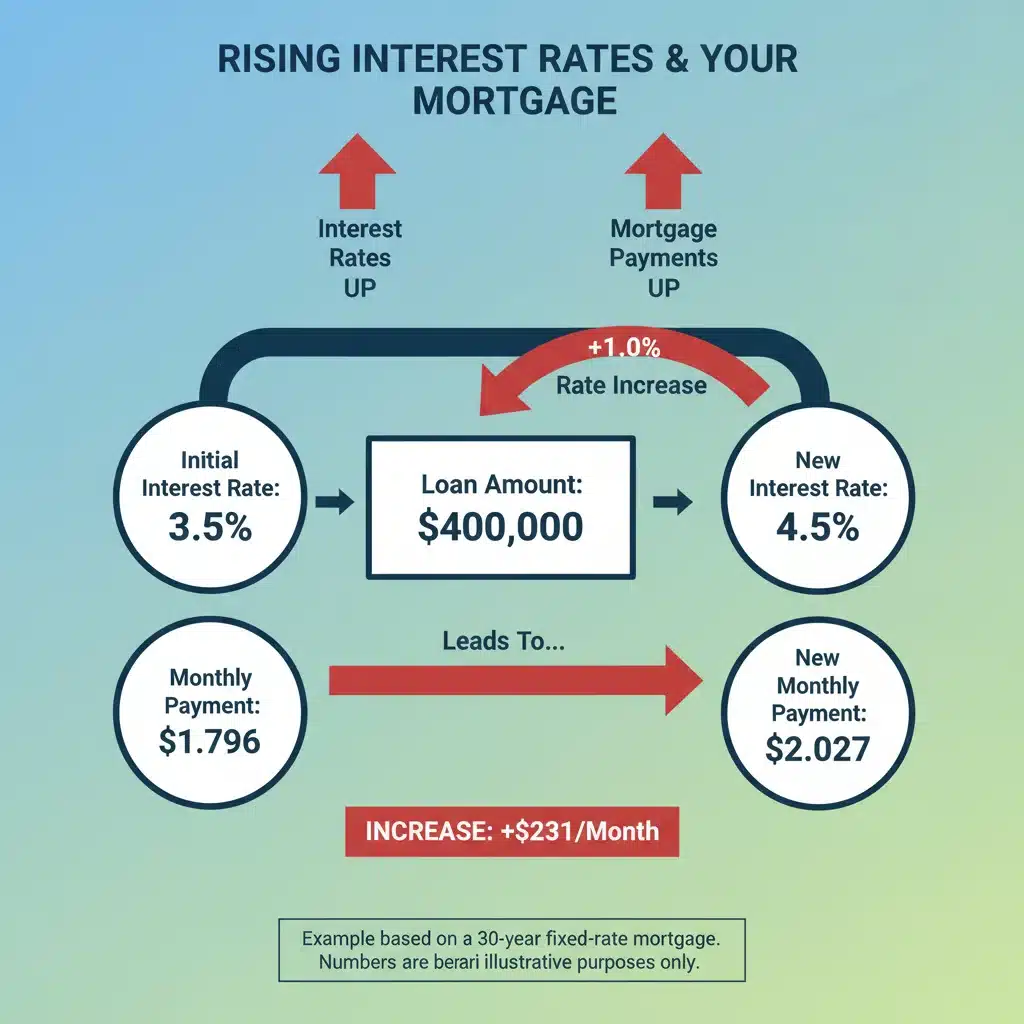
When mortgage rates climb, the monthly payments for new home loans become more expensive. For instance, a rise of just one percentage point on a $400,000 mortgage can add hundreds of dollars to a borrower’s monthly expense, significantly impacting their debt-to-income ratio and overall affordability. This can price some prospective buyers out of the market entirely, particularly those at the lower end of the income spectrum or in highly competitive regions. The net effect is often a cooling of buyer demand, which can, in turn, slow down home price appreciation or even lead to price declines in certain areas.
The phenomenon of rising borrowing costs also affects adjustable-rate mortgages (ARMs). While fixed-rate mortgages lock in an interest rate for the life of the loan, ARMs have rates that reset periodically. Homeowners with ARMs reaching their reset period during a time of high Fed Rate Hikes 2026 could see their monthly payments jump substantially, potentially creating financial strain. It is crucial for ARM holders to understand their loan terms and prepare for potential payment increases.
Impact on Refinancing Activity
Higher mortgage rates also significantly dampen refinancing activity. Homeowners who secured historically low rates in previous years will find little incentive to refinance if current rates are higher than their existing ones. This reduction in refinancing means less liquidity flowing through the housing market and can impact mortgage lenders’ profitability. For homeowners considering a cash-out refinance to access home equity, the higher interest rates might make this option less attractive, potentially shifting their financial strategies.
Slowing Housing Market Dynamics
Beyond individual affordability, the cumulative effect of Fed Rate Hikes 2026 can lead to a broader slowdown in the housing market. Reduced buyer demand, combined with potentially higher inventory as some homeowners decide to sell before rates climb further, can shift the market from a seller’s to a buyer’s advantage. This might result in longer listing times, fewer bidding wars, and a more normalized pace of home price growth, a stark contrast to the rapid appreciation seen in recent years.
Real estate investors, too, feel the pinch. Higher borrowing costs mean lower potential returns on rental properties or development projects, forcing them to re-evaluate their acquisition strategies and projected cash flows. For those considering selling, a slower market might necessitate adjustments to pricing expectations. The overall impact is a more cautious and measured housing market, where strategic planning and financial resilience become even more critical.
Navigating Investment Strategies Amidst Rising Rates
The investment landscape undergoes a significant transformation during periods of Fed Rate Hikes 2026. Different asset classes react in distinct ways, creating both headwinds and tailwinds for investors. A well-diversified portfolio and a clear understanding of these dynamics are essential for successful navigation.
Bonds and Fixed Income
Typically, when interest rates rise, bond prices fall. This inverse relationship is fundamental to bond investing. Existing bonds, which offer a lower fixed interest payment, become less attractive compared to newly issued bonds that offer higher yields. Investors holding existing bonds might see the market value of their holdings decrease. However, for new money entering the bond market, higher rates present an opportunity to lock in more attractive yields. Short-term bonds tend to be less sensitive to interest rate changes than long-term bonds, making them a potentially safer bet in a rising rate environment. Investors might consider shifting towards shorter-duration bonds or laddering their bond portfolios to mitigate interest rate risk and capitalize on new, higher-yielding opportunities.
Stocks and Equities
The impact of Fed Rate Hikes 2026 on the stock market is more nuanced. Generally, higher interest rates can be a negative for equities for several reasons:
- Higher Borrowing Costs for Companies: Businesses that rely on debt for expansion, operations, or acquisitions face increased interest expenses, which can eat into their profits and reduce earnings per share.
- Reduced Consumer Spending: As borrowing costs for consumers rise (e.g., mortgages, credit cards), disposable income may decrease, leading to lower consumer spending, which can hurt companies’ revenues.
- Discounting Future Earnings: Higher interest rates are used to discount future corporate earnings to their present value. A higher discount rate means future earnings are worth less today, potentially reducing stock valuations, especially for growth stocks that are valued based on long-term future earnings.
- Alternative Investments: Higher bond yields make fixed-income investments more attractive relative to stocks, as investors can earn a decent return with less risk, potentially drawing capital away from equities.
However, not all sectors are equally affected. Companies with strong balance sheets, low debt, and consistent cash flows tend to weather rising rates better. Value stocks, which are often less reliant on future growth projections and more on current earnings, might also outperform growth stocks in such an environment. Sectors like financials (banks benefit from higher net interest margins) and some utilities (which have stable demand) might also show resilience.

Real Estate Investments (Beyond Primary Residence)
For real estate investors, the dynamics are similar to the broader housing market but with additional considerations. Higher interest rates increase the cost of financing for commercial properties, development projects, and rental portfolios. This can reduce property valuations and cap rates, making it harder to achieve desired returns. However, in certain segments, like industrial or multi-family housing in high-demand areas, strong rental income growth might offset some of the financing costs. Investors may need to adjust their leverage, focus on properties with strong cash flow fundamentals, or explore markets with robust economic growth and demographic trends that can sustain demand.
Alternative Investments
In a rising rate environment, alternative investments can offer diversification and potentially uncorrelated returns. Commodities, for example, can sometimes act as an inflation hedge, although their performance is also influenced by global supply and demand. Private equity and venture capital might face higher borrowing costs, but their long-term investment horizons can sometimes insulate them from short-term market fluctuations. Investors might also look at inflation-indexed securities, like Treasury Inflation-Protected Securities (TIPS), which are designed to protect against inflation.
Strategies to Mitigate Risks and Capitalize on Opportunities
Given the significant impact of Fed Rate Hikes 2026, proactive financial planning is paramount. Here are some strategies for homeowners and investors:
For Homeowners and Prospective Buyers:
- Lock in Rates: If you are in the process of buying a home, consider locking in your mortgage rate as soon as possible to protect against further increases.
- Improve Credit Score: A higher credit score can help you qualify for the best possible interest rates, even in a rising rate environment.
- Increase Down Payment: A larger down payment reduces the amount you need to borrow, thereby lessening the impact of higher interest rates on your monthly payments.
- Evaluate ARMs: If you have an adjustable-rate mortgage, understand when your rate is scheduled to adjust and plan for potential payment increases. Consider refinancing to a fixed-rate mortgage if it makes financial sense, though the current high rates might make this less appealing.
- Budget Wisely: Re-evaluate your household budget to account for potentially higher housing costs and reduced discretionary spending.
For Investors:
- Review Portfolio Diversification: Ensure your portfolio is adequately diversified across different asset classes, sectors, and geographies to spread risk.
- Focus on Quality: Invest in companies with strong fundamentals, healthy balance sheets, consistent earnings, and competitive advantages that can withstand economic headwinds.
- Re-evaluate Bond Holdings: Consider adjusting the duration of your bond portfolio, potentially favoring shorter-term bonds or bond funds to reduce interest rate sensitivity. Explore inflation-protected securities.
- Consider Value Stocks: In a rising rate environment, value stocks might offer more stability and better relative performance compared to high-growth stocks.
- Explore Dividend Stocks: Companies that consistently pay dividends can provide a steady income stream, which can be attractive when other asset classes are volatile.
- Stay Informed: Continuously monitor economic data, Federal Reserve announcements, and market trends to make timely adjustments to your strategy.
- Consult a Financial Advisor: A professional advisor can help you tailor a strategy specific to your financial goals, risk tolerance, and current market conditions.
The Broader Economic Outlook for 2026 and Beyond
The Fed Rate Hikes 2026 are not just about mortgages and investments; they reflect a broader economic strategy aimed at achieving sustainable growth and price stability. The Fed’s actions signal a commitment to taming inflation, even if it means some short-term economic slowdown. While higher rates can cool demand and potentially lead to a mild recession, the goal is to avoid a more severe economic downturn caused by runaway inflation.
Looking ahead, the trajectory of future rate hikes will largely depend on how inflation evolves and how the labor market responds. If inflation shows signs of decelerating consistently, the Fed might pause its hiking cycle or even consider rate cuts down the line. Conversely, persistent inflationary pressures could necessitate further tightening. Economic forecasts for 2026 will continue to be heavily influenced by these monetary policy decisions, global geopolitical developments, and ongoing supply chain dynamics.
For consumers, this means a continued focus on financial resilience. Building an emergency fund, managing debt prudently, and having a clear financial plan become even more crucial. For businesses, adapting to higher borrowing costs and potentially softer consumer demand will require strategic adjustments in pricing, operations, and investment plans. The ability to innovate and maintain efficiency will be key to thriving in this environment.
Conclusion
The three latest Fed Rate Hikes 2026 have undeniably reshaped the financial landscape, presenting both challenges and opportunities for individuals and investors. From the increased cost of homeownership to the recalibration of investment portfolios, understanding the ripple effects of these monetary policy decisions is fundamental to sound financial management. While the immediate impact might feel restrictive, these actions are part of a larger effort by the Federal Reserve to foster long-term economic stability and combat inflationary pressures.
By staying informed, adopting prudent financial strategies, and consulting with financial professionals, you can effectively navigate this evolving economic climate. Whether it’s securing a mortgage, adjusting your investment strategy, or simply planning your household budget, being proactive and adaptable will be your greatest assets in 2026 and the years to come. The future is uncertain, but with knowledge and strategic planning, you can position yourself for continued financial success.