Mastering 2026 IRS Tax Code Changes: Your Guide to Maximizing Deductions

Anúncios
The year 2026 looms large on the horizon for U.S. taxpayers, marking a significant juncture in the nation’s tax landscape. As many provisions of the Tax Cuts and Jobs Act (TCJA) of 2017 are set to expire, individuals and businesses alike face a potential paradigm shift in how their income, investments, and deductions are treated by the Internal Revenue Service (IRS). Understanding these impending 2026 IRS Tax Changes is not merely a matter of compliance; it’s a critical strategic imperative for maximizing your financial well-being and avoiding unwelcome surprises.
This comprehensive guide delves deep into the expected modifications, offering a roadmap to navigate the complexities and empowering you with the knowledge to proactively plan for the future. From individual income tax rates and standard deductions to specific credits and business implications, we’ll dissect what’s changing and, more importantly, how you can adapt to maximize your deductions and optimize your overall tax strategy.
The Expiring Provisions of the TCJA: What’s on the Chopping Block?
The Tax Cuts and Jobs Act of 2017 brought about the most sweeping tax reforms in decades, significantly altering the tax code for both individuals and corporations. However, many of its most impactful provisions for individuals were temporary, designed to sunset at the end of 2025. This means that as of January 1, 2026, unless Congress acts to extend them, these provisions will revert to their pre-TCJA status. This reversion forms the core of the 2026 IRS Tax Changes that taxpayers need to be aware of.
Anúncios
Individual Income Tax Rates
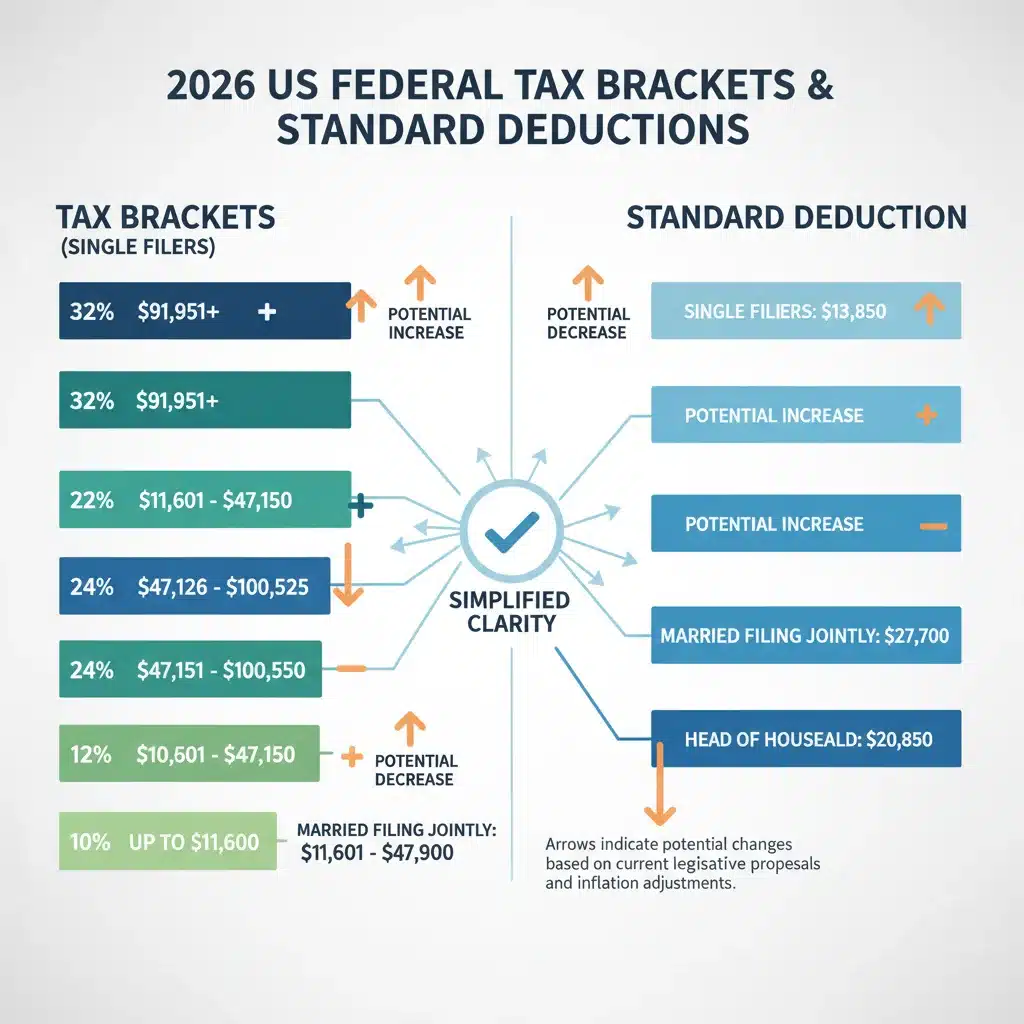
One of the most prominent changes under TCJA was the reduction in individual income tax rates across most brackets. For 2026, without legislative intervention, these rates are slated to revert to their higher, pre-TCJA levels. For instance, the top individual income tax rate, currently 37%, could climb back to 39.6%. Similarly, other brackets will likely see increases. This means that for many taxpayers, more of their income could be subject to higher taxation, directly impacting their take-home pay and overall financial planning.
Standard Deduction Amounts
The TCJA significantly increased the standard deduction, nearly doubling it for many filers. This made it more advantageous for a vast number of taxpayers to claim the standard deduction rather than itemize. In 2026, these increased standard deduction amounts are set to expire, potentially reverting to lower levels (adjusted for inflation). This change will have a profound effect on how many taxpayers approach their deductions, possibly making itemizing more appealing for a larger segment of the population.
State and Local Tax (SALT) Deduction Cap
Perhaps one of the most contentious provisions of the TCJA was the $10,000 cap on deductions for state and local taxes (SALT). This cap disproportionately affected residents in high-tax states. Upon expiration, the SALT deduction cap could be lifted, allowing taxpayers to deduct the full amount of their state and local taxes once again. This would provide significant relief for many homeowners and high-income earners in affected regions.
Child Tax Credit and Other Family-Related Credits
The TCJA also enhanced the Child Tax Credit, increasing its value and expanding its refundability for many families. While there have been temporary expansions since, the core TCJA changes to this credit are also set to expire. This could mean a reduced credit amount and stricter eligibility requirements for the Child Tax Credit and potentially other family-related tax benefits, impacting families’ financial planning.
Miscellaneous Itemized Deductions
The TCJA eliminated many miscellaneous itemized deductions that were previously subject to the 2% adjusted gross income (AGI) floor, such as unreimbursed employee business expenses, tax preparation fees, and investment expenses. These deductions are not expected to return in 2026 under current law, but their absence continues to shape how taxpayers approach their itemized deductions.
Anúncios
Estate and Gift Tax Exemption
For high-net-worth individuals, the TCJA significantly increased the estate and gift tax exemption amount. This exemption is also scheduled to revert to its pre-TCJA levels (adjusted for inflation) in 2026. This change could have substantial implications for estate planning, potentially subjecting more wealth to federal estate taxes.
Impact on Individuals: Navigating the New Landscape
The 2026 IRS Tax Changes will necessitate a fresh look at personal financial planning. The reversion of tax rates and standard deductions alone will require many to re-evaluate their budgeting, savings, and investment strategies.
Higher Taxable Income for Many
With potentially higher tax rates across the board, individuals may find that a larger portion of their income is subject to taxation. This could lead to a decrease in disposable income, affecting spending habits, savings rates, and investment capacities. Understanding your new effective tax rate will be crucial.
Re-evaluating Itemized vs. Standard Deduction
The reduced standard deduction amounts could make itemizing deductions more attractive for a broader range of taxpayers. It will be essential to meticulously track all eligible expenses, such as mortgage interest, charitable contributions, and medical expenses (exceeding the AGI threshold), to determine if itemizing offers a greater tax benefit than the new standard deduction.
Strategic Tax Planning for Families
Families accustomed to the enhanced Child Tax Credit and other family-related benefits will need to adjust their financial forecasts. Understanding the new credit amounts and eligibility rules will be vital for planning for childcare, education, and other family expenses.
Retirement Planning Adjustments
Changes in tax rates can influence the effectiveness of various retirement savings vehicles. For instance, if tax rates are expected to be higher in retirement, Roth contributions (taxed now) might become more appealing than traditional IRA/401(k) contributions (taxed in retirement). Conversely, if rates are expected to drop, traditional options might still hold an advantage. Consulting with a financial advisor to re-evaluate your retirement strategy in light of the 2026 IRS Tax Changes is highly recommended.
Impact on Businesses: Adjusting to Evolving Regulations
While the corporate tax rate of 21% established by the TCJA is permanent, other provisions affecting pass-through entities and specific business deductions are also subject to the 2026 sunset. This means businesses, particularly small and medium-sized enterprises (SMEs) and those structured as pass-through entities, will need to pay close attention to the impending changes.
Qualified Business Income (QBI) Deduction (Section 199A)
The 20% Qualified Business Income (QBI) deduction for pass-through entities (sole proprietorships, partnerships, S corporations) was a significant benefit under the TCJA. This deduction is also set to expire at the end of 2025. Its removal would mean a substantial increase in the tax burden for many small business owners and self-employed individuals. Businesses relying on this deduction will need to factor its absence into their financial projections and potentially explore alternative business structures or tax strategies.
Bonus Depreciation and Section 179 Expensing
While not a direct sunset, bonus depreciation, which allowed businesses to immediately deduct 100% of the cost of eligible new and used business property, began to phase down in 2023 and will continue to do so, reaching 0% by 2027. Section 179 expensing remains a valuable tool, but the phasing out of bonus depreciation will alter capital expenditure planning for many businesses. Understanding the remaining bonus depreciation schedule and maximizing Section 179 expensing will be critical for businesses looking to invest in new assets.
Interest Expense Deduction Limitations
The TCJA also introduced limitations on the deduction of business interest expense, generally capping it at 30% of adjusted taxable income (ATI). While this provision is not set to expire, the calculation of ATI changes in 2022, making the limitation more restrictive for some businesses. Businesses with significant debt or large interest expenses need to be aware of how these rules continue to impact their deductions.
Research and Development (R&D) Expensing Changes
Starting in 2022, the TCJA mandated that R&D expenses must be amortized over five years (or 15 years for foreign R&D), rather than being immediately expensed. While not a 2026 expiration, this ongoing change continues to impact businesses engaged in R&D, affecting their cash flow and tax liability. Businesses need to factor this into their innovation and development budgets.
Strategies for Maximizing Deductions Amidst the Changes
Proactive planning is the cornerstone of effective tax management, especially with the impending 2026 IRS Tax Changes. Here are several strategies individuals and businesses can employ to maximize deductions and minimize their tax burden:
1. Re-evaluate Your Deduction Strategy Annually
With the potential reversion of the standard deduction, it’s more important than ever to compare the standard deduction against your potential itemized deductions. Keep meticulous records of all eligible expenses throughout the year. For individuals, this includes mortgage interest, property taxes (if the SALT cap is lifted), charitable contributions, and medical expenses. For businesses, track all operational costs, depreciable assets, and eligible professional fees.
2. Bunching Deductions
If the standard deduction reverts to lower levels, “bunching” deductions could become a more effective strategy. This involves concentrating deductible expenses into a single tax year to exceed the standard deduction threshold, then taking the standard deduction in alternate years. For example, making two years’ worth of charitable contributions in one year or scheduling significant medical procedures in a year where you plan to itemize.
3. Maximize Retirement Contributions
Contributing the maximum allowable to tax-advantaged retirement accounts like 401(k)s, IRAs, and HSAs remains one of the most effective ways to reduce taxable income. These contributions are often pre-tax, reducing your current year’s taxable income, and grow tax-deferred. The 2026 IRS Tax Changes might increase the value of these deductions if tax rates rise.
4. Utilize Tax-Loss Harvesting
For investors, tax-loss harvesting involves selling investments at a loss to offset capital gains and potentially up to $3,000 of ordinary income. This strategy can be particularly valuable in volatile markets and helps manage your overall tax liability. The rules around capital gains and losses are generally less affected by the TCJA expirations, making this a consistent strategy.
5. Review Investment Strategies
Consider the tax efficiency of your investment portfolio. Tax-advantaged accounts like 529 plans for education savings or municipal bonds (which offer tax-exempt interest) can be excellent tools for reducing your overall tax burden, especially if income tax rates increase in 2026.
6. Business Structure Review
For business owners, especially those operating as pass-through entities, a review of your business structure might be warranted if the QBI deduction expires. While changing structures has its own complexities and costs, understanding the tax implications of different entities (e.g., C-Corp vs. S-Corp vs. Partnership) can help optimize your tax position in the post-2025 landscape.
7. Capital Expenditure Planning
With bonus depreciation phasing out, businesses need to carefully plan their capital expenditures. Maximizing Section 179 expensing and understanding the remaining bonus depreciation schedule can help accelerate deductions for new equipment and property. Consider making significant purchases before the end of 2025 if full bonus depreciation is still available and beneficial.
8. Stay Informed and Consult Professionals
Tax laws are complex and constantly evolving. The most crucial strategy is to stay informed about legislative developments and to consult with qualified tax professionals, such as CPAs or financial advisors. They can provide personalized advice tailored to your specific financial situation and help you navigate the nuances of the 2026 IRS Tax Changes effectively.

The Importance of Proactive Planning
The adage “an ounce of prevention is worth a pound of cure” rings particularly true when it comes to tax planning. Waiting until the last minute to understand and react to the 2026 IRS Tax Changes can lead to missed opportunities for savings and potential penalties. Proactive planning allows you to:
- Optimize Your Cash Flow: By understanding your future tax liability, you can better manage your income and expenses, ensuring you have sufficient funds for both short-term needs and long-term goals.
- Maximize Deductions and Credits: Knowing what deductions and credits will be available (or revert) enables you to strategically position yourself to take full advantage of them.
- Avoid Surprises: Tax law changes can sometimes lead to unexpected tax bills. Forward-thinking planning helps you anticipate these changes and adjust accordingly.
- Make Informed Financial Decisions: Whether it’s deciding on a major purchase, planning for retirement, or structuring a business, understanding the tax implications is vital for making sound financial choices.
- Reduce Stress: The tax season can be a source of significant stress. With a well-thought-out plan, you can approach tax time with confidence and peace of mind.
Potential Legislative Action: A Wildcard
It’s important to acknowledge that the current projections for 2026 are based on existing law, which dictates the expiration of the TCJA provisions. However, Congress always has the power to intervene. Lawmakers could choose to extend some or all of the expiring provisions, modify them, or introduce entirely new tax legislation. The political landscape, economic conditions, and the outcome of future elections will all play a role in determining whether and how these laws might change.
This legislative uncertainty underscores the need for flexibility in your tax planning. While planning based on current law is prudent, it’s equally important to stay abreast of legislative discussions and be prepared to adapt your strategies if new laws are enacted.
Conclusion: Preparing for a New Tax Era
The 2026 IRS Tax Changes represent a significant shift that will impact nearly every U.S. taxpayer. From individual income tax rates and standard deductions to the Qualified Business Income deduction and estate tax exemptions, the landscape is poised for a substantial transformation. While the specifics may seem daunting, approaching these changes with a proactive and informed mindset is the best defense.
By understanding the expiring provisions, assessing their potential impact on your personal and business finances, and implementing strategic planning measures, you can not only navigate these changes but also maximize your deductions and optimize your financial position. Remember, the key to success in this evolving tax environment lies in continuous learning, meticulous record-keeping, and, most importantly, seeking expert advice from qualified tax professionals. Start your planning today to ensure a smooth transition into the new tax era of 2026 and beyond.