2026 Social Security COLA: What Beneficiaries Can Expect and How to Plan

Anúncios
Understanding the future of your Social Security benefits is a cornerstone of effective retirement planning. As we look ahead, the 2026 Social Security COLA (Cost-of-Living Adjustment) is a topic of significant interest for millions of Americans. This annual adjustment is designed to help Social Security benefits keep pace with inflation, ensuring that the purchasing power of beneficiaries is maintained. However, predicting the exact figure can be complex, as it relies on economic data that won’t be fully available until much closer to the announcement date. This comprehensive guide will delve into what the 2026 Social Security COLA might entail, how it’s calculated, and what beneficiaries can do to prepare for its impact on their financial landscape.
The Importance of the Cost-of-Living Adjustment (COLA)
For many retirees, disabled individuals, and survivors, Social Security benefits represent a significant, if not primary, source of income. Without regular adjustments, the value of these benefits would erode over time due to inflation. Imagine trying to buy groceries or pay for utilities with the same amount of money you received a decade ago; it would be far more challenging. This is precisely why the COLA exists – to protect beneficiaries from the diminishing effects of rising prices. The 2026 Social Security COLA will be a critical factor in determining the financial well-being of millions, influencing everything from daily expenditures to long-term budgeting.
The concept of COLA was introduced in 1975, and since then, it has become an integral part of the Social Security system. It’s not an arbitrary increase; rather, it’s a mechanism designed to reflect real-world economic changes. While some years see substantial increases, others might have more modest adjustments, all depending on the prevailing economic conditions. This makes understanding the COLA not just a matter of curiosity but a vital component of financial literacy for anyone relying on these benefits.
Beneficiaries often eagerly anticipate the COLA announcement, usually made in October, as it directly impacts their monthly income for the following year. A higher COLA can provide much-needed relief from rising costs, while a lower one might necessitate more stringent budgeting. Therefore, staying informed about the factors influencing the 2026 Social Security COLA is paramount for proactive financial planning.
Anúncios
How the Social Security COLA is Calculated
The calculation of the Social Security COLA is not a mysterious process, though it does involve specific economic indicators. The Social Security Administration (SSA) uses the Consumer Price Index for Urban Wage Earners and Clerical Workers (CPI-W) to determine the annual adjustment. Specifically, it compares the average CPI-W for the third quarter (July, August, and September) of the current year to the average CPI-W for the third quarter of the most recent year in which a COLA was payable. The percentage increase between these two periods, if any, becomes the COLA for the following year.
It’s important to note that if there is no increase in the CPI-W, or if it decreases, then there is no COLA for that year. This has happened in the past, though it is less common. The use of the CPI-W is intended to reflect the spending patterns of a specific segment of the population, which is considered representative of Social Security beneficiaries. While some argue that a different index, such as the CPI-E (Consumer Price Index for the Elderly), might be more appropriate, the CPI-W remains the official metric.
For the 2026 Social Security COLA, the SSA will look at the CPI-W data from July, August, and September of 2025 and compare it to the third-quarter CPI-W from 2024. The difference will then be applied to benefits starting in January 2026. This forward-looking approach means that while we can make educated guesses based on current economic trends, the definitive number won’t be known until late 2025.
The Role of Inflation in COLA Determination
Inflation is the primary driver of the COLA. When the cost of goods and services rises, the purchasing power of a fixed income decreases. The COLA is designed to counteract this effect. High inflation typically leads to a higher COLA, while low inflation or deflation can result in a smaller or even no COLA. Therefore, keeping an eye on inflation reports and economic forecasts is crucial for anyone trying to anticipate the 2026 Social Security COLA.
Anúncios
Factors contributing to inflation are numerous and complex, including energy prices, food costs, housing, and supply chain issues. Global events, government policies, and consumer demand all play a role. Predicting these factors accurately over a long period is challenging, which is why early COLA predictions are often subject to significant revision. Beneficiaries should view initial projections as estimates and remain flexible in their financial planning.
Historical COLA Trends and What They Tell Us About 2026
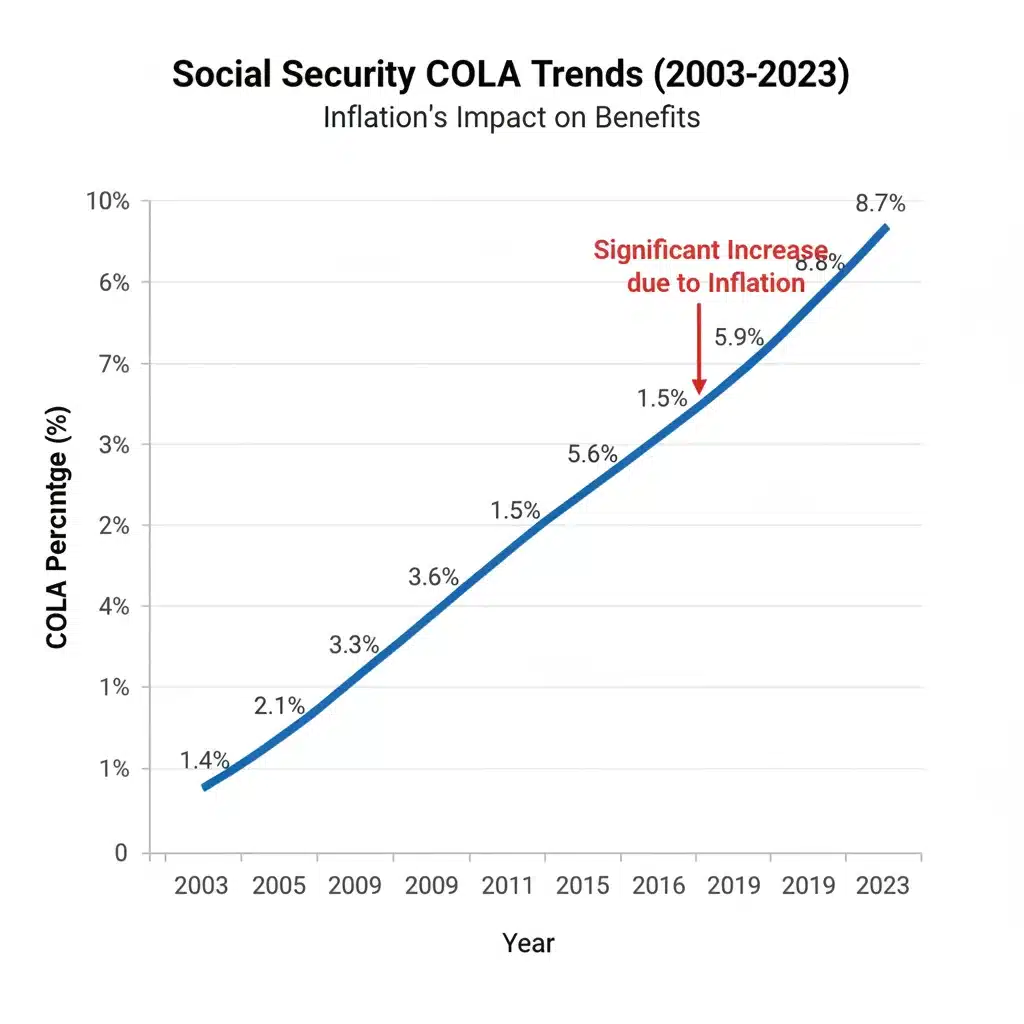
Examining historical COLA trends can offer valuable insights, though past performance is not a guarantee of future results. Over the past few decades, COLA percentages have varied significantly. There have been periods of high inflation leading to substantial increases, such as the 5.9% COLA for 2022 and the 8.7% COLA for 2023, which were a direct response to soaring inflation rates. Conversely, there have been years with no COLA, such as 2010, 2011, and 2016, due to very low or negative inflation.
These fluctuations highlight the dynamic nature of the economy and its direct impact on Social Security benefits. When considering the 2026 Social Security COLA, it’s essential to look at the broader economic climate. Are inflation rates projected to remain elevated, or are they expected to moderate? What are the forecasts for energy and food prices? These questions will be central to any informed prediction.
Analysts often use various economic models and projections to estimate future COLA figures. While these projections can provide a range, they are constantly updated as new economic data becomes available. Beneficiaries should consult reputable financial news sources and the Social Security Administration’s official announcements for the most accurate and up-to-date information.
What Beneficiaries Can Expect for the 2026 Social Security COLA
While it’s too early to provide a definitive figure for the 2026 Social Security COLA, we can discuss the factors that will likely influence it. Current economic forecasts suggest a potential moderation of inflation compared to the peaks seen in 2022 and 2023. However, inflation could still remain above historical averages, leading to a respectable COLA.
Experts are closely watching key economic indicators such as:
- Energy Prices: Fluctuations in oil and gas prices have a significant impact on the CPI-W.
- Food Costs: Food inflation is a major concern for many households and directly affects the COLA calculation.
- Housing Costs: Rent and homeownership expenses are substantial components of the CPI-W.
- Wage Growth: While not directly tied to the COLA calculation, strong wage growth can contribute to inflation.
- Federal Reserve Policy: Interest rate decisions by the Federal Reserve aim to control inflation, which in turn influences the COLA.
Based on preliminary outlooks, many economists anticipate a COLA for 2026 that is likely to be lower than the record-breaking increases of 2023 but still positive. A range of 2% to 4% is often cited in early discussions, though this is purely speculative at this stage. It’s crucial for beneficiaries to understand that these are early predictions and subject to change as more data becomes available throughout 2025.
The ultimate determination will hinge on the CPI-W data from the third quarter of 2025. Until then, beneficiaries should focus on sound financial planning strategies that can adapt to various COLA outcomes.
How to Plan for the 2026 Social Security COLA
Regardless of the exact percentage, proactive planning is essential for Social Security beneficiaries. Here are several strategies to help you prepare for the 2026 Social Security COLA and manage your finances effectively:
-
Review Your Budget Annually:
Even with a COLA, it’s wise to review your household budget at least once a year. Assess your income and expenses to identify areas where you can save or reallocate funds. A potential COLA increase should not lead to immediate overspending, but rather a strategic adjustment to your financial plan.
-
Consider the Impact on Other Benefits:
A COLA increase can sometimes affect eligibility for other means-tested benefits, such as Medicaid or SNAP. While Social Security benefits are generally protected, it’s important to understand how an increase might interact with other assistance programs you receive. Consult with a financial advisor or a benefits specialist if you have concerns.
-
Evaluate Your Healthcare Costs:
Medicare Part B premiums are often deducted directly from Social Security benefits. Historically, a COLA increase can sometimes be offset by a rise in Medicare premiums, especially for higher-income beneficiaries. Keep an eye on Medicare premium announcements, usually made around the same time as the COLA, to understand the net impact on your take-home benefit.
-
Build an Emergency Fund:
Having an emergency fund is always a good idea, particularly for those on a fixed income. This fund can provide a buffer against unexpected expenses or periods of higher-than-anticipated inflation, regardless of the COLA. Aim for at least three to six months’ worth of essential living expenses.
-
Diversify Income Streams:
While Social Security is a vital component, relying solely on it can be risky. If possible, explore ways to diversify your income streams. This could include part-time work, investments, or drawing from retirement savings like 401(k)s or IRAs. A diversified income approach provides greater financial security and flexibility, especially in years with a lower 2026 Social Security COLA.
-
Stay Informed:
Keep abreast of economic news and official announcements from the Social Security Administration. Subscribing to newsletters or following reliable financial news outlets can help you stay updated on COLA projections and the final determination. Knowledge is power when it comes to managing your retirement finances.
Potential Challenges and Considerations
While the COLA is designed to be beneficial, there are several challenges and considerations for beneficiaries:
The ‘Hold Harmless’ Provision and Medicare Premiums
One significant factor for many beneficiaries is the ‘hold harmless’ provision. This rule prevents Medicare Part B premiums from increasing a beneficiary’s net Social Security benefit below the previous year’s level. If the Part B premium increase is greater than the COLA increase, the ‘hold harmless’ provision ensures that the beneficiary’s net benefit does not decrease. However, this provision primarily applies to those who have their Part B premiums deducted directly from their Social Security checks and do not pay income-related monthly adjustment amounts (IRMAA). It’s a complex area, and understanding its implications for your specific situation is crucial when the 2026 Social Security COLA is announced.
Inflationary Pressures on Specific Expenses
Even with a COLA, some beneficiaries may find that their personal inflation rate, particularly for essential items like healthcare and housing, outpaces the general CPI-W. The CPI-W reflects a broad basket of goods and services, and individual spending patterns can differ significantly. This means that while the COLA provides a general adjustment, it may not perfectly match every individual’s cost-of-living increases. This disparity underscores the importance of personalized budgeting and financial planning.
Taxation of Social Security Benefits
A COLA increase can also have implications for the taxation of Social Security benefits. If your combined income (adjusted gross income + non-taxable interest + one-half of your Social Security benefits) exceeds certain thresholds, a portion of your Social Security benefits may become taxable. An increase in your benefits due to the 2026 Social Security COLA could potentially push you into a taxable bracket or increase the taxable portion of your benefits. It’s advisable to consult with a tax professional to understand these potential effects.

Long-Term Outlook for Social Security and COLA
Beyond the immediate 2026 Social Security COLA, it’s important to consider the long-term health of the Social Security program. The annual Trustees’ Report provides projections on the program’s financial status, including its ability to pay full benefits in the future. While there are ongoing discussions about potential reforms to ensure long-term solvency, these changes would likely be gradual and would not typically impact the fundamental mechanism of the COLA.
The COLA itself is a dynamic tool designed to adapt to economic realities. As long as inflation remains a factor in the economy, the COLA will continue to play a crucial role in preserving the purchasing power of Social Security benefits. However, beneficiaries should always factor in the possibility of varying COLA amounts in their long-term financial projections, recognizing that periods of low inflation or even deflation could lead to smaller or no adjustments.
Engaging with financial planning professionals can provide personalized advice tailored to your unique circumstances, helping you navigate the complexities of Social Security and retirement income planning effectively. They can help you model different COLA scenarios and develop strategies to ensure your financial security well into the future.
Conclusion: Preparing for Your Financial Future with the 2026 Social Security COLA
The 2026 Social Security COLA is an anticipated adjustment that will play a significant role in the financial lives of millions of beneficiaries. While the exact percentage remains unknown until late 2025, understanding how it’s calculated, reviewing historical trends, and recognizing the factors that influence it are crucial steps in proactive financial planning. Inflation, economic forecasts, and policy decisions will all contribute to the final determination.
By actively reviewing your budget, considering the impact on other benefits and Medicare premiums, building an emergency fund, and diversifying your income streams, you can position yourself to adapt to whatever the 2026 COLA brings. Staying informed through official announcements and credible financial news sources will empower you to make timely and informed decisions.
Ultimately, the COLA is a testament to the Social Security program’s commitment to providing a safety net that evolves with the economy. By taking a thoughtful and prepared approach, beneficiaries can ensure that their financial well-being remains stable and secure, allowing them to enjoy their retirement with greater peace of mind. The future of your financial security is a journey, and understanding the 2026 Social Security COLA is an important milestone along that path.